
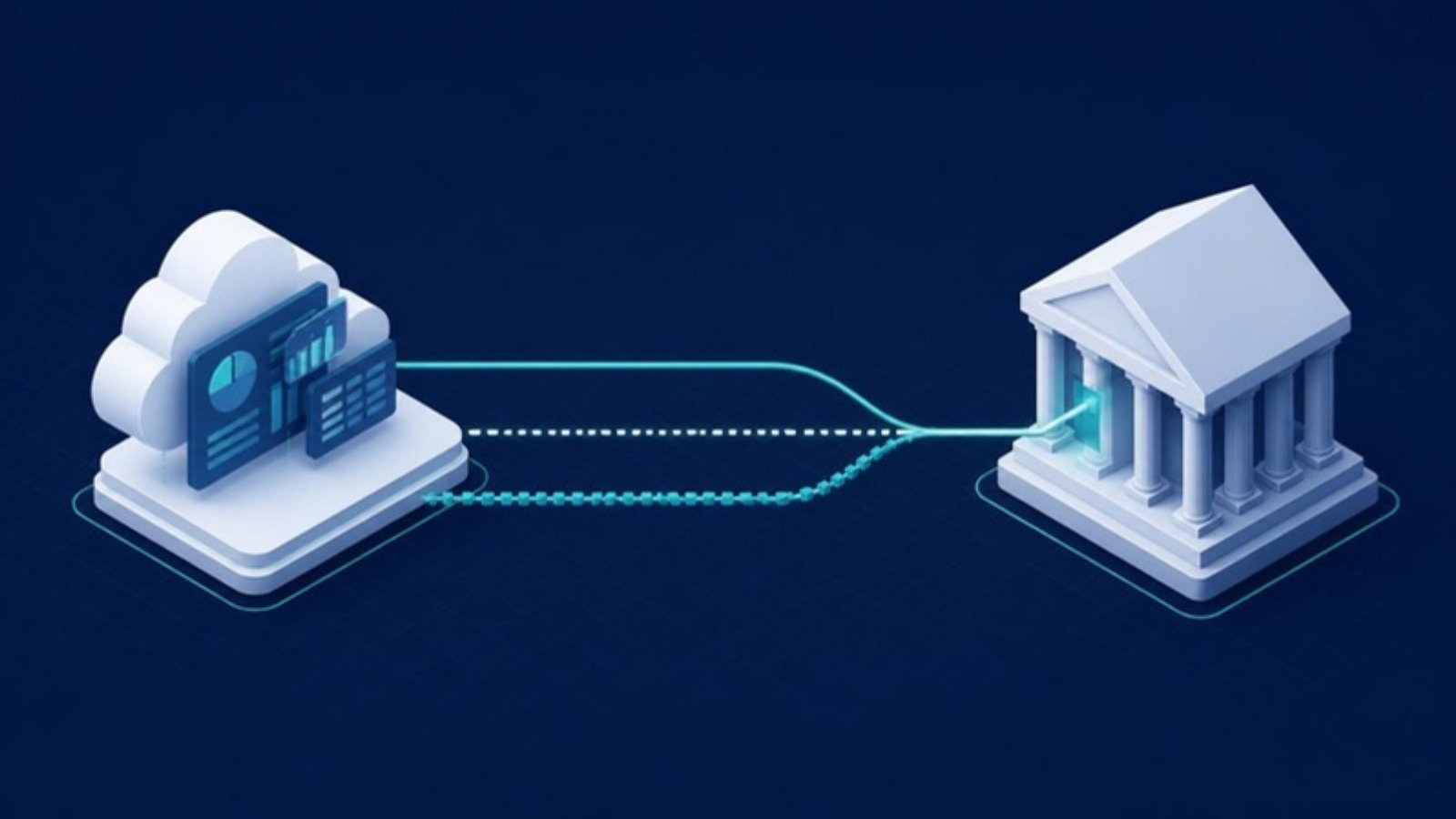
Sage Intacct handles the accounting, but sending payments to the bank and retrieving statements goes through a banking communication channel. To connect Sage Intacct to your bank, three options come up most often: EBICS, Open Banking (PSD2) and SFTP. This article compares them to help you choose based on your banks and your organization.
What a bank connection needs to cover
A complete connection works in both directions: sending orders (credit transfers as pain.001, direct debits as pain.008) and receiving feedback and statements (pain.002, camt.052, camt.053, camt.054). Without automation, these exchanges rely on exports, manual imports and separate bank portals, with re-keying and delays.
EBICS: the channel for corporate flows
EBICS is a standardized banking protocol widely used in France, Germany and Switzerland. It relies on keys or certificates specific to each subscriber and supports order signing, including distributed electronic signature (VEU). It suits regular volumes and contexts requiring multiple signatures. The differences between versions are covered in EBICS 2.5 vs 3.0.
Open Banking PSD2: API access
Open Banking allows account access and payment initiation through APIs, with the account holder's consent. It is useful when a bank does not offer EBICS or when a fast setup is needed. Availability and scope depend on each bank. The full comparison is in Open Banking PSD2 vs EBICS.
SFTP: file exchange
SFTP means dropping and retrieving files on a secure server. Some banks still offer it, or use it for specific flows. Signature and control mechanisms depend on the bank, so the security of the whole chain needs particular attention.
How to choose
- Your bank: the available channel is first the one it offers. Check before starting the project.
- The level of control: if multiple signatures are required, EBICS with VEU is often the best fit.
- The number of banks: a multi-bank group frequently combines several channels.
- Setup time: an EBICS subscription requires an initialization step with the bank.
Use cases
- Single-bank SMEs: one channel, often EBICS, is enough.
- Mid-market and multi-bank groups: a mix of EBICS, Open Banking and SFTP depending on the institution.
- Accounting firms: many client files with varied banks, see centralizing multi-client payments.
What Arkaio brings
Arkaio supports EBICS, Open Banking and SFTP, along with pain.001, pain.002, pain.008, camt.052, camt.053, camt.054 and LCR formats. Users approve invoices in Sage Intacct; payment selection, bank submission and reconciliation then happen in Arkaio, with entries posted back to Sage Intacct. For the EBICS channel, the full flow is described on the EBICS Connector for Sage Intacct page. Arkaio has been available in the Sage catalog since September 23, 2026.
Key takeaways
There is no universal channel: the right choice depends on the bank, the level of control expected and the volume. What matters is an automated, secure and traceable connection, whichever channel is used. To see how this would work with your banks, contact us for a demo.