
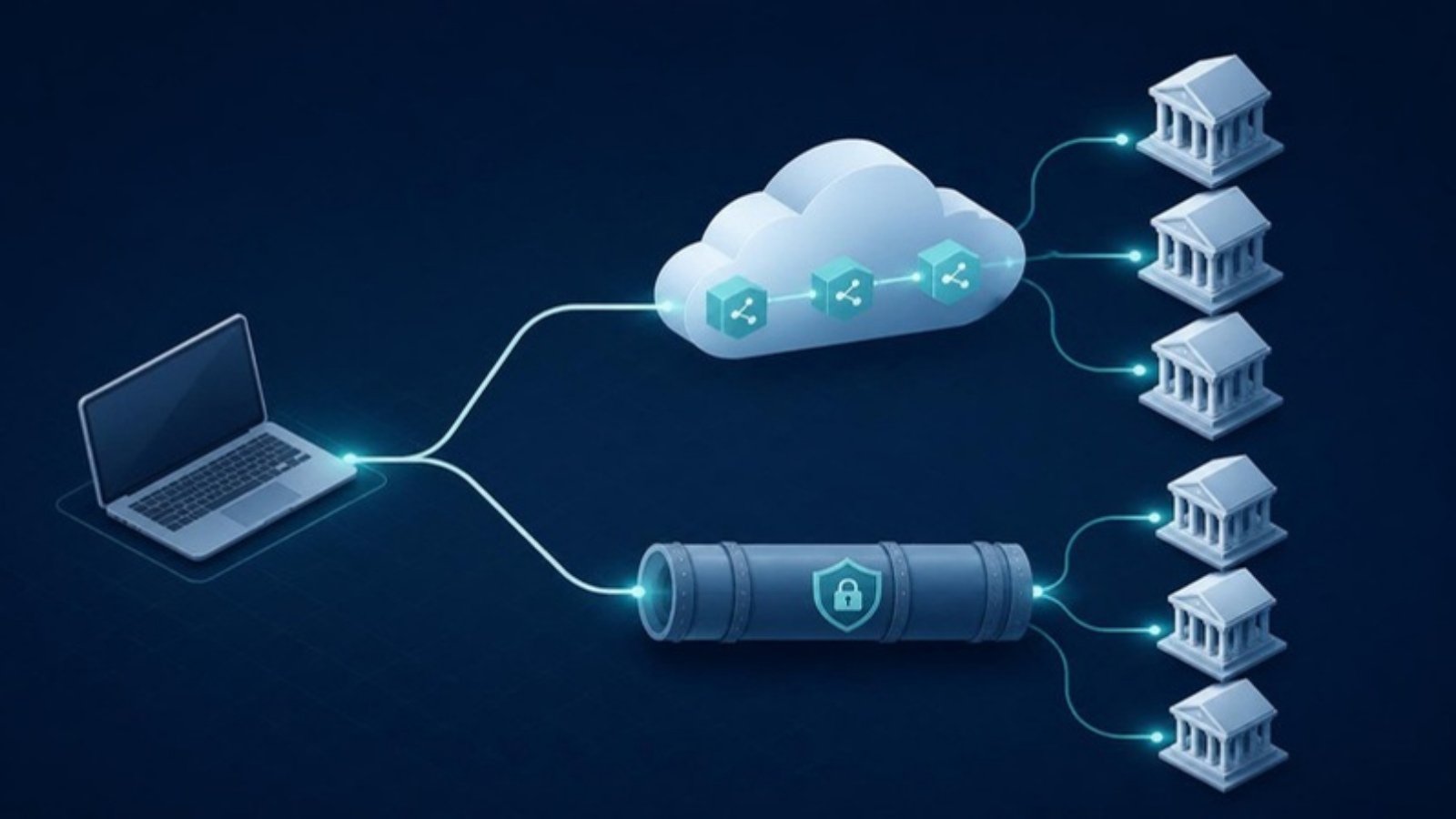
Open Banking PSD2 or EBICS: the question comes up as soon as a company wants to automate payments and statements. Both connect an ERP such as Sage Intacct to a bank, but they do not cover the same operations. The answer depends on the bank, the country, the volume and the level of control expected. This article compares the two channels point by point.
EBICS: the protocol for corporate flows
EBICS is a standardized banking protocol, widely used in France, Germany, Austria and Switzerland. The company signs a contract with its bank and becomes a "subscriber", with its own keys or certificates. It sends payment files (pain.001 for credit transfers, pain.008 for direct debits) and retrieves statements: camt.053 at end of day, camt.052 intraday, camt.054 for transaction notifications. Distributed electronic signature (VEU) lets several signatories approve the same order. For protocol versions, see EBICS 2.5 vs 3.0.
Open Banking PSD2: API access
The European PSD2 directive requires banks in the EU and EEA to open access to payment accounts to licensed providers. With the account holder's consent, a provider can read accounts (balances, transactions) and, where the bank allows it, initiate a payment. Setup is fast: the account holder authenticates with their bank, with no prior technical contract.
In return, scope depends on each bank's API. Some only open account access. Bulk payments are not available everywhere. Each payment initiated is confirmed with strong customer authentication. Account access consent must be renewed regularly, at most every 180 days in the European Union.
Point-by-point comparison
| Criterion | EBICS | Open Banking PSD2 |
|---|---|---|
| Framework | Contract between the company and its bank | PSD2 regulation, through a licensed provider |
| Setup | Key initialization, signed letter, activation within a few days | Online consent, within minutes |
| Credit transfers | Bulk pain.001 files, from a few lines to several thousand | Single payments; bulk depends on the bank |
| SEPA direct debits | Yes, pain.008 files | Not covered by PSD2 |
| Statements | ISO 20022 camt.052, camt.053, camt.054 | Balances and transactions via API, in each bank's format |
| Approval | Multiple signatures (VEU) | Strong authentication by the bank user |
| Renewal | Certificates, per the bank's policy | Consent to renew, at most every 180 days |
| Coverage | Mainly France, Germany, Austria, Switzerland | EU and EEA banks subject to PSD2 |
The case of Switzerland
Switzerland does not apply PSD2. Swiss banks open their APIs on a voluntary basis, often through platforms such as SIX's bLink, with a scope that varies from bank to bank. For Swiss companies, EBICS remains the reference channel for payments and statements.
How to choose for your situation
- Your bank: the available channel is first the one it offers. Some banks offer only EBICS, others only APIs, and not every Open Banking interface allows payments. The list of compatible banks shows what is possible for each one.
- Volume: for regular, high-volume payment runs, EBICS is the usual channel; for small volumes or account access only, Open Banking may be enough.
- Collections: if you collect from customers by direct debit, you need EBICS to send pain.008 files.
- Control: if several signatures are required, EBICS with VEU is the best fit.
- Lead time: Open Banking starts within minutes; EBICS needs a few days of initialization with the bank.
Use cases
- Single-bank SMEs: one channel is enough, usually the one the bank recommends.
- Mid-market and multi-bank groups: a mix is common, EBICS for the main banks and Open Banking for statements from secondary banks.
- Companies operating in France and Switzerland: EBICS on the Swiss side, EBICS or Open Banking on the French side depending on the banks.
- Accounting firms: many clients with varied banks, see centralizing your clients' payments.
Security and control
Both channels are secure, but control sits in a different place. With EBICS, the signatories designated by the company approve orders, with rights set up at the bank. With Open Banking, the bank user confirms each operation. Either way, the internal approval workflow (who prepares, who approves, above which amount) must be organized upstream. See also IBAN fraud and dual validation.
Limits
No channel is universal. Not every bank allows payments through Open Banking, and not every bank offers EBICS to small clients. The features actually available should be checked bank by bank before starting a project.
How Arkaio addresses this
Arkaio supports EBICS, Open Banking and SFTP, along with pain.001, pain.002, pain.008, camt.052, camt.053 and camt.054 formats. Each bank is connected through the channel it offers, and retrieved statements feed automated bank reconciliation in Sage Intacct, whatever the channel. How the EBICS connection works is detailed on the EBICS Connector for Sage Intacct page.
Frequently asked questions
Can SEPA direct debits be collected through Open Banking?
No. PSD2 covers account access and credit transfer initiation. SEPA direct debits use pain.008 files, sent over EBICS or another channel offered by the bank.
How long does Open Banking consent last?
In the European Union, account access must be reconfirmed with strong authentication at most every 180 days. A reminder before expiry avoids gaps in statements.
Does Open Banking work with Swiss banks?
Switzerland is not subject to PSD2. API access depends on each bank; EBICS remains the most widely used channel for businesses.
Key takeaways
- EBICS covers bulk transfers, direct debits, ISO 20022 statements and multiple signatures.
- Open Banking starts quickly, but its scope depends on each bank and excludes direct debits.
- In Switzerland, outside PSD2, EBICS remains the reference.
- The two channels combine well in a multi-bank group.